
What leaders can borrow from coaching to build confidence, encourage ownership, and help people navigate change.
One of the interesting things about adding organizational development coaching to my professional toolkit this year has been learning when to resist an instinct I've spent much of my career developing: figuring out what needs to happen next.
As a consultant, I'm often brought into an organization because leaders want another perspective, a recommendation, or help getting something across the finish line. I genuinely enjoy connecting the dots, untangling complicated situations, and helping people move from uncertainty to a practical plan.
Coaching has also challenged me to get more comfortable with a different kind of contribution. I’ve been reminded that sometimes the most useful thing I can do is ask a question, leave a little room for the answer, and trust that the other person has something valuable to bring to the conversation (well, of course they do!).
I'll admit, when you're accustomed to being the person who helps move things forward, there's an adjustment involved in not immediately implementing a fix. I like a good plan, a clear next step, and the satisfaction of crossing something off a list.
Coaching has been a useful reminder that sometimes the thinking itself is the progress.
But as I've been developing my coaching skills, I've started noticing how many of these practices also apply to organizational change.
Leaders are often responsible for introducing new processes, implementing technology, communicating decisions, and helping teams adjust to new expectations. They need to provide direction and keep things moving. At the same time, the people experiencing those changes need opportunities to think, contribute, build confidence, and exercise their own judgment.
And sometimes, borrowing a few practices from coaching can help create that space. Here are five practices I've been reflecting on over the last few months.
1. Resist the urge to immediately provide the answer
When someone comes to us with a problem, offering a solution often feels like the most helpful response…especially when we recognize the situation and have some experience navigating it ourselves.
It's an understandable impulse. It feels good to help someone solve a problem, especially when we happen to know the answer. (And let's admit it, being right can feel pretty satisfying, too.) There are certainly situations when offering that answer is exactly what the person needs.
But I've been learning to pay closer attention to the moments when being the person with the answer might unintentionally take away an opportunity for someone else to develop their own solution.
Imagine a team member struggling with a new project management tool. They come to their leader because they can't figure out how to organize their work within the new system.
The leader could demonstrate the preferred approach and send them on their way. Problem solved, at least for today.
Or instead they might first ask, "What have you tried so far?" or "How would you like to organize the work?"
Those questions might reveal that the employee already has a reasonable approach but needs clarification about expectations. Perhaps they've even identified a better way to use the tool that the organization hasn't considered.
Of course, if they genuinely don't know how to perform a required task, a demonstration or some additional training may be appropriate. After all, there's no prize for making someone discover a software feature that you could explain in 30 seconds.
The opportunity is in recognizing when someone needs information and when they might actually benefit from some extra space to think through a challenge.
One small coaching practice I'm working on is asking a clear question and then stopping. Period. No immediate rephrasing, adding three qualifiers, or attaching a second question before the person has had a chance to answer. And believe me, I’ve tossed out double-barreled questions with the best of them in the past!
It sounds simple. In practice, however, it's surprisingly easy to keep talking and forget to demonstrate restraint.
2. Look beyond the individual to the system around them
Once we get comfortable resisting the urge to immediately solve someone's problem, there's another important consideration: making sure we're looking at the right problem in the first place.
This one connects particularly closely with my consulting work. I've spent a lot of time looking at how processes, technology, communication, and people's responsibilities fit together. And I've learned that when someone is struggling with a change, it's worth looking beyond the individual before deciding what needs to improve.
Coaching often focuses on helping someone explore their own thinking, experiences, and choices. But in an organizational setting, those experiences don't happen in isolation.
People operate within systems of expectations, processes, technology, relationships, and competing priorities. Considering what else people are carrying during organizational change can help us recognize when those systems are contributing to the challenges they're experiencing.
Imagine an employee who is having trouble adopting a new workflow. Their leader might reasonably wonder whether they need additional training, more confidence, or help managing their time.
Those are all possibilities worth exploring.
But what if the employee is also being asked to maintain the old process while learning the new one? What if different leaders have communicated conflicting expectations? Or perhaps the workflow requires approvals from people who aren't consistently available?
The employee may be doing everything they reasonably can within a system that isn't supporting the change. And if that’s the case, no amount of encouragement or confidence-building will resolve an approval bottleneck that nobody has the authority to address.
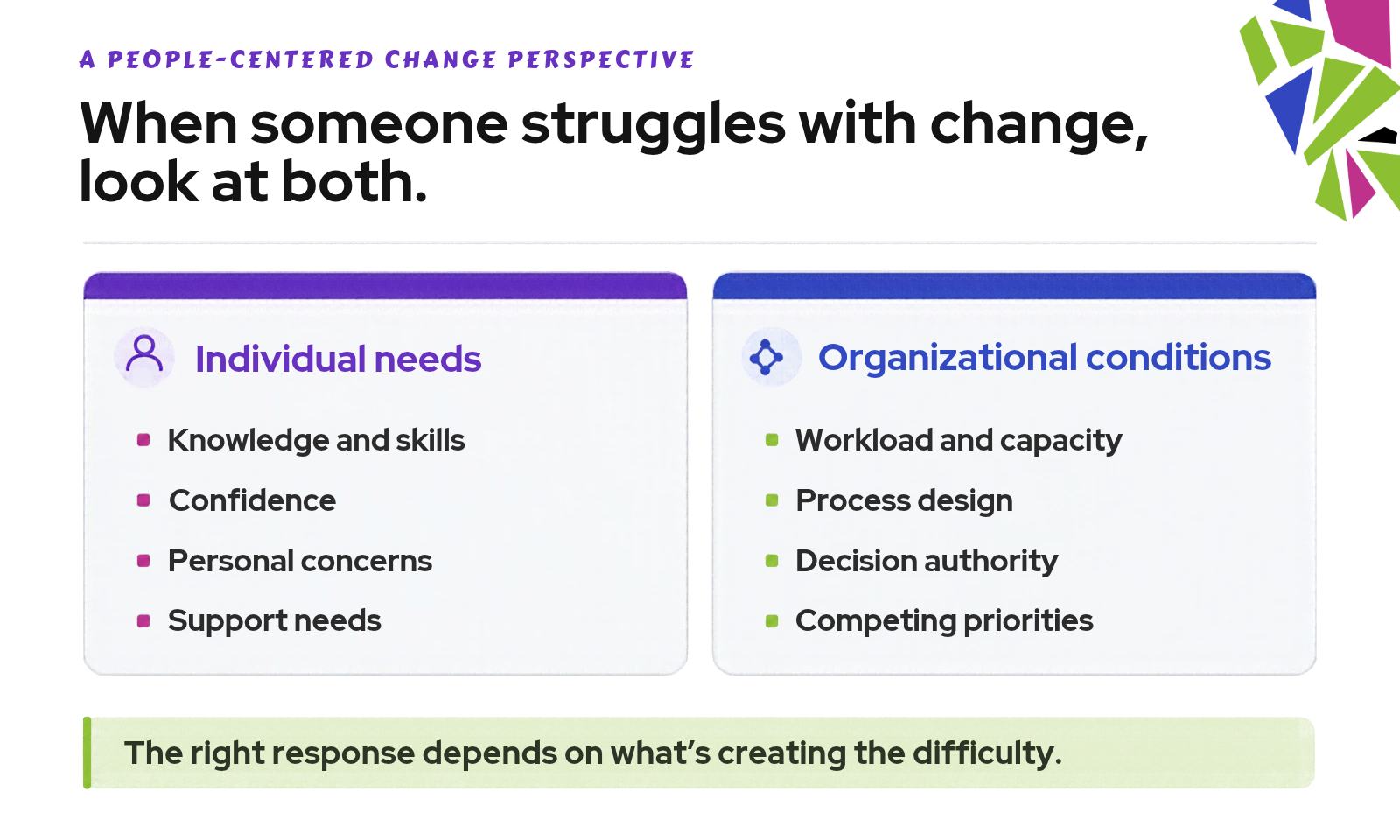
A useful question might be, "What's making this harder than it needs to be?"
Then comes the important part: being willing to act on what we learn.
Sometimes the answer calls for individual support. Other times, leaders need to clarify responsibilities, adjust priorities, remove barriers, or reconsider how work has been designed.
This is where I think coaching practices and organizational development complement each other especially well.
We can help individuals recognize their choices and capabilities while also acknowledging that the organization has a responsibility to create conditions in which people can succeed.
We shouldn't expect employees to personally compensate for every weakness in the systems around them.
3. Make room for mixed emotions about change
One of the things I appreciate about coaching is the opportunity to explore feelings that might initially seem contradictory.
We tend to talk about organizational change in terms of support and resistance. Are employees excited about the new direction, or are they pushing back?
Human reactions are rarely that neat and tidy.
Someone can believe a new CRM will help their organization serve customers more effectively while also feeling nervous about learning the system. They can be excited about a promotion and concerned about taking on direct reports or leaving behind work they've mastered. They might even support a decision wholeheartedly while feeling disappointed about what it means for their daily routine.
Those reactions can coexist. I'm willing to bet you've experienced that yourself at some point.
When leaders interpret uncertainty as opposition, they may feel compelled to convince employees that the change is a good thing. But someone who already understands the benefits may not need another explanation of why the organization is moving forward.
They just might need room to acknowledge what feels difficult, instead.
A coaching-inspired question could be, “What concerns do you have about this change?”
After listening to their response, we might explore another perspective: “What possibilities do you see in the new approach?”
Our objective isn't to eliminate every uncomfortable feeling or convince someone to be enthusiastic. Rather, it's to understand how they're experiencing the change, including the possibility that they see both benefits and challenges.
Understanding those reactions can also help us recognize how change affects someone's sense of identity at work, even when they agree with the reasons behind it.
4. Notice and name the capabilities people demonstrate
This is another one of the practices I'm actively working on in my own coaching development. I've always appreciated the value of encouragement, but I'm learning that there's an important difference between telling someone they've done something well and helping them recognize what they did that made a difference.
When someone makes progress, our natural response might be to say an affirming, "Great job!" or "That's a really good idea!"
There's nothing wrong with encouragement, but consider what happens when we get more specific about what the person actually did.
Let's say an employee notices that a revised onboarding workflow is creating confusion between HR and a department manager. Rather than waiting for someone else to fix it, they bring the right people together, clarify the handoff, and suggest an adjustment.
A leader could simply thank them for resolving the issue…or they could say, "You recognized that the handoff wasn't working, involved the people who needed to weigh in, and helped us find a better approach."
The second response highlights more than a successful outcome because it helps the employee recognize the judgment, initiative, and problem-solving skills they specifically demonstrated.
So why does that matter during organizational change? Because change often asks people to become learners again. Someone who felt highly competent in the previous way of working may suddenly feel less certain about their abilities.
Recognizing the capabilities they're already using to adapt can help reinforce their confidence.
I'm also learning that there's value in noticing moments when someone shifts their own perspective. Perhaps they recognize an assumption they've been making or identify an alternative they hadn't previously considered.
Rather than immediately moving to the next action item, we can acknowledge what just happened. It's a small way of helping people see their own resourcefulness, especially when they're navigating unfamiliar territory.
5. Let people help define the next step
Eventually, reflection needs to connect with action. This is yet another area where coaching has influenced my thinking over the past year.
I'm accustomed to helping organizations translate discussions into plans, complete with responsibilities, timelines, and next steps. That's valuable work, particularly when a team needs clarity about how to move forward.
However, there's a difference between assigning an action and inviting someone to help shape it.
Consider a team that's trying a revised process for handling client requests. After the first couple of weeks, employees identify several things that aren't working as expected.
A leader could review the feedback, decide what needs to change, and announce the adjustments.
Alternatively, the leader might invite the team to consider which issue would be most useful to address first, what they could reasonably test, and what support they'd need.
That doesn't mean every decision becomes a group vote. Leaders still need to establish priorities, communicate boundaries, and make decisions that affect the broader organization.
But within those boundaries, there's often room for people closest to the work to contribute to the next step.
Depending on where the conversation goes, a few questions worth considering are:
What adjustment do you think would make the biggest difference?
What obstacles might prevent that from working?
What support or decisions do you need from me?
When should we check back to see whether it helped?
These conversations can create more meaningful ownership while also giving leaders a clearer picture of what's realistic.
And when employees help identify an adjustment, they may be better positioned to recognize whether it's actually improving their work.
Knowing when to coach and when to lead
As I continue developing my organizational development coaching skills, one of the things I'm appreciating most is that coaching and consulting serve different purposes.
There are times when people need expertise, clear direction, a decision, or help implementing something complicated. I'm certainly not planning to abandon those contributions. They're a big part of the work I enjoy!
But there are also moments when offering an immediate answer, even a perfectly reasonable one, might prevent us from learning something important about the person, the situation, or the system.
The skill is recognizing which approach is most useful.
For organizational leaders, that might mean making more room for reflection before solving a problem, acknowledging that employees can hold competing feelings about change, or recognizing the capabilities people demonstrate as they adapt.
It might also mean looking beyond individual behavior to understand whether the organization's own processes and expectations are making change harder than necessary.
None of these practices requires leaders to become professional coaches. They're simply additional ways to help people participate meaningfully in changes that affect their work.
That's one of the things I'm enjoying about adding coaching to my toolkit. It's challenging me to think a little differently about when to jump in with an answer and when to give someone else room to find their own. And I suspect that's a distinction I'll keep practicing long after my formal training is finished.
The next time someone comes to you with a challenge related to organizational change, consider what they need most in that moment. Is it an answer, an opportunity to think, or help removing something that's standing in their way?
Knowing the difference can make a meaningful impact on how people experience change.
Need a partner to help your organization navigate change?
I work with leaders to make organizational change more manageable by connecting people, process, technology, and communication. Let's explore how Mosaic BizOps can help.
