
What a six-question conversation guide taught us about listening before making changes.
At the recent ATD Central Indiana Learning Summit, I asked for two volunteers to read a short role-play during my session on Agile Lite practices for learning and change.
It took a little coaxing. Being willing to attend a session and being willing to become part of the session are, understandably, two different commitments. Eventually, two people agreed, and I handed each of them a script.
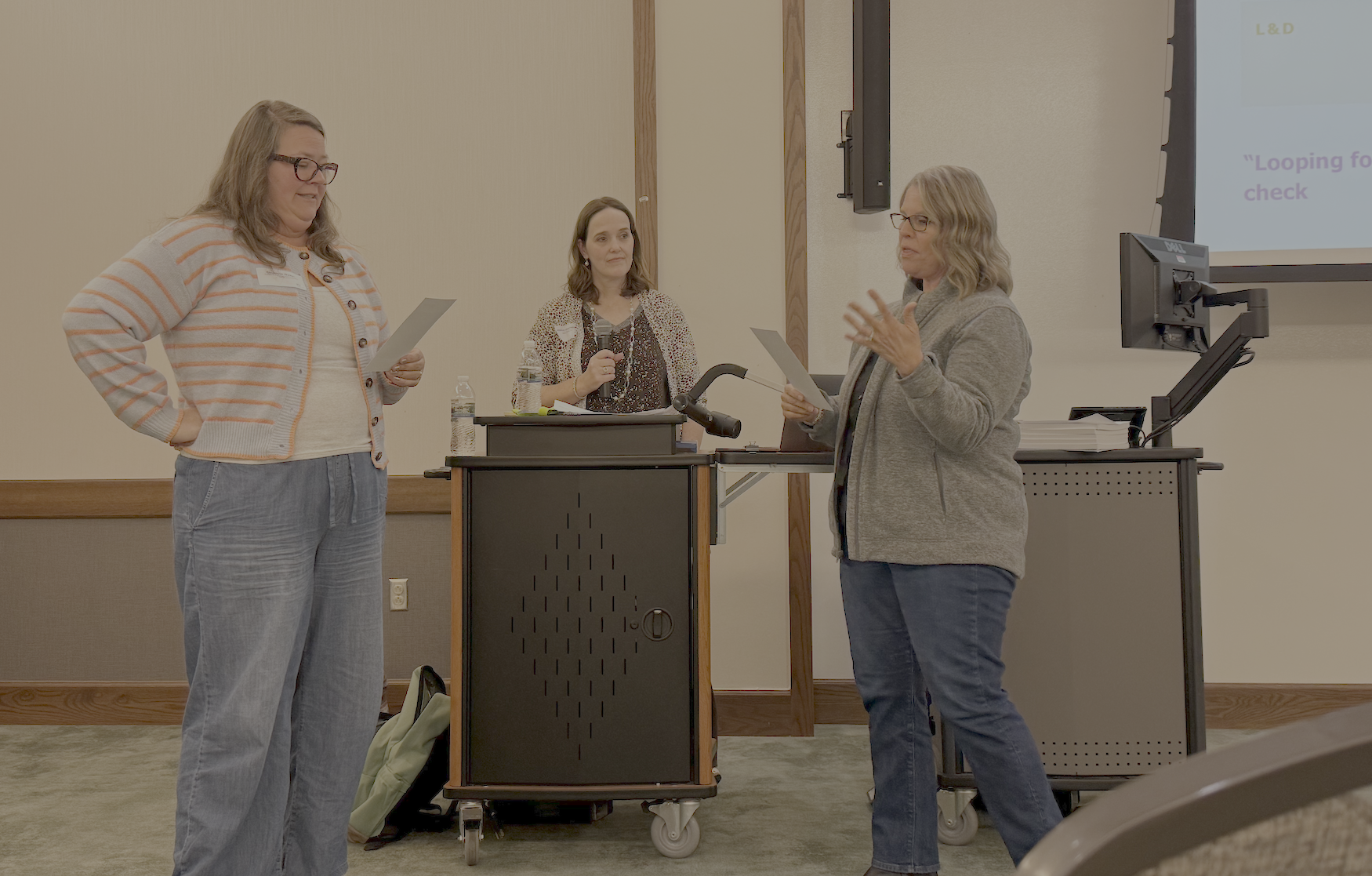
Two attendees during my session at the ATD-CIC Annual Learning Summit role playing a script to model a conversation between a manager and representative of the L&D department.
One played a manager who had tried a new six-question conversation guide during a one-on-one. The other played someone from learning and development (L&D) who wanted to understand how it went.
The manager opened with: “I tried the guide yesterday. Honestly, it felt like one more thing.”
Sound familiar?
If you've introduced a new process, tool, or training program, you've probably heard some version of that response. You've put thought into something intended to help, and you can see how it could make work easier or more effective. Then, someone tries it and experiences just another demand on their time.
My gut instinct in situations like this is often to start figuring out what we can fix. “Is six questions too many? Let's make it three!” Or, “maybe we need a shorter guide, a better example, or another explanation of why this matters.”
Those might all be reasonable solutions. The trouble is, we haven't learned enough to know which one would actually help.
What we learned by asking one more question
In our fictional scenario, the L&D colleague resisted the temptation to jump straight into problem-solving. Instead, they asked the manager to walk through what happened.
The manager explained that their employee, Sam, had arrived with two things she wanted to discuss. They started there, as they usually did. Ten minutes into the meeting, the manager looked down and realized there were still six questions to get through.
The L&D colleague offered an interpretation:
“So by the time you got to the guide, you felt rushed. Am I hearing that right?”
“Partly.”
That one word mattered.
The manager went on to explain that one of Sam's concerns had actually fit the guide's first question. They'd already discussed it. But the manager asked the question again anyway.
Sam's response was perfectly reasonable: “Didn't we just cover that?”
When the L&D colleague asked why the manager had repeated it, the answer revealed something important:
“I figured someone would ask whether I'd used all six.”
Now we had a better understanding of what was happening. Yes, the manager was concerned about time. But they were also trying to reconcile two expectations: having a useful conversation with their employee and demonstrating that they'd followed the new guide…that they’d “understood the assignment.”
What they really needed to know was whether following Sam's lead still counted as using the guide.
Cutting the guide from six questions to three wouldn't necessarily have resolved that uncertainty. In fact, we might have made the resource shorter while leaving the underlying confusion untouched.
Why it's so tempting to jump to a solution
Believe me, I understand the appeal of responding quickly when someone tells us something isn't working. We want to demonstrate that we're listening, that we care about their experience, and that we're willing to make adjustments. We can fix it!
Besides, there's something satisfying about having a concrete task to tackle. Shorten the guide. Update the instructions. Send a clarification. Check, check, check. Progress!
But understanding someone's experience doesn't always lead us to an immediately actionable task. Actually, sometimes it reveals conflicting expectations, an assumption we didn't realize we'd made, or a decision that requires someone else's involvement.
And sometimes…the thing we thought was the problem turns out to be only part of it.
I've seen similar situations arise with workplace technology and processes. Someone using a new project management system might enter the same update in multiple places because they're unsure which one their leader actually checks. Or, someone following a revised approval process might keep seeking permission because they don't know which decisions they're now empowered to make independently.
From the outside, we might conclude that the person needs more training or clearer instructions. Maybe they do. But first, wouldn't it help to understand what they believe they're being asked to do? That kind of curiosity needs structure, especially when we're eager to move forward.
Give people a chance to correct your understanding
In his book Supercommunicators, Charles Duhigg describes a practice called “looping for understanding.” You ask a question, summarize what you heard in your own words, and check whether you understood correctly.
It's that last part I find particularly valuable.
We can ask thoughtful questions and listen carefully while still arriving at an incomplete interpretation. And once we think we've figured something out, it's surprisingly easy to stop exploring and start solving, isn’t it?
In our role-play, the L&D colleague's first interpretation wasn't wrong. The manager did feel rushed. But by checking that interpretation instead of treating it as a conclusion, they gave the manager an opportunity to say, “Partly,” and explain what was missing.
There's a meaningful difference between deciding privately that we understand someone and giving that person an opportunity to confirm or correct our understanding. The second requires us to stay curious a little longer, even when a perfectly good solution is already forming in our “fix it” oriented brains.
After the volunteers finished, I asked the audience what they understood now that they couldn't have known from the manager's opening comment. They recognized the distinction. What initially sounded like a concern about workload also involved uncertainty about expectations.
That was exactly the kind of learning I'd hoped the activity would illustrate.
My list of possibilities was still only my list
Earlier in the session, I'd asked participants to imagine they were L&D professionals preparing to introduce the six-question guide. Without having all the details, what would they normally consider to help an initiative like this succeed?
One participant raised neurodivergence and how people might interpret instructions or communication situations differently.
I appreciated that contribution because it introduced a consideration I hadn't specifically included in my preparation. It was a useful reminder that even when we think we've anticipated the factors that could affect a change, our own perspective has limits.
Of course, we can't assume what an individual needs or experiences based on a label. But we can be more intentional about inviting different perspectives and making room for people to explain what would help them participate.
That might mean clarifying which parts of a process are required and where people can exercise judgment. Or, it could also mean providing concrete examples alongside general instructions or offering different ways to share feedback rather than relying entirely on a group conversation.
This observation naturally connected to the role-play later in the session because both experiences demonstrated the value of making room for information we hadn't anticipated.
One part of designing change that people can realistically navigate is making room for those perspectives. Before introducing something new, we can ask what people think might help or get in the way. After they've tried it, we can ask what actually happened.
Both of those opportunities matter, and both require some willingness to discover that our original understanding was incomplete.
What we do with what we've learned
This is where the connection to Agile Lite becomes particularly practical.
One of the ideas I emphasized during my presentation was the value of trying something on a manageable scale, gathering feedback, and making adjustments while there's still time to learn from them.
But simply asking for feedback doesn't guarantee we'll learn what we need to know. The questions we ask influence what people tell us, and the assumptions we bring into the conversation influence what we hear.
Think about the difference between asking our fictional manager, “Did you use all six questions?” and “Walk me through how you used the guide.”
The first question could reinforce the very misunderstanding that made the guide frustrating, while the second gives us a better opportunity to understand how the resource fits into the manager's actual work.
Of course, we can't stop at understanding. Feedback becomes useful when we do something thoughtful with what we've learned.
In this scenario, that might mean clarifying that the guide is intended to support a productive conversation, not serve as a checklist. We'd also want to confirm that expectation with the appropriate leader rather than assuming everyone agrees. Aligning expectations with stakeholders isn't something we can do once at the beginning and assume will hold throughout an initiative.
And if one manager was confused, you can bet that there's a reasonable chance others might be, too.
Once we've communicated the clarification, we can check back after the next round of one-on-ones.
Did it help?
Are managers using the guide more comfortably?
Is there something else we hadn't considered?
That's a much more informative feedback loop than shortening the document and assuming we've solved the problem.
The same approach works for plenty of changes beyond learning and development, whether you're rolling out new software, adjusting an internal workflow, or introducing a different way for teams to communicate.
The next time someone shares frustration with a change you've introduced, consider trying three things:
Ask about their experience. “Walk me through what happened when you tried it.”
Check your interpretation. “Here's what I think you're saying. What have I missed?”
Agree on something to test. Identify an adjustment, clarify who needs to be involved, and decide when you'll check back.
None of these steps requires a formal Agile implementation or a complicated change management framework. They do require us to resist the urge to treat our first interpretation as the whole story.
When someone says, “This feels like one more thing,” remember that they've given us a starting point. Before turning that feedback into an action item, give them room to explain what they mean.
Think about a change you've introduced recently. What did you assume when someone struggled with it, and have you given them a chance to tell you, “Partly”?
