Building Bridges, Not Burnout: A Human-Centered Way to Navigate Organizational Change
Most organizations don’t struggle with change. They struggle with the space in between. That is, the murky middle where the old way no longer works, the new way isn’t fully clear, and everyone is quietly wondering, “Are we sure this thing won’t collapse under us?”
You’ve probably felt that space before.
A new workflow rolls out and managers are nodding… but also sweating. A tool gets introduced and staff agree it “could be helpful” yet no one is using it. A restructuring begins and suddenly every conversation feels slightly more emotionally charged than usual.
Teams rarely resist the change itself. They resist the ambiguity, the pace, and the very understandable fear of falling through the cracks.
And that’s where I want to offer an approachable, more human way forward — one rooted in a story from my own family.
Because long before I was helping teams navigate change, someone else in my family was building bridges in a much more literal way.
The Story That Built This Framework
My great-grandfather, Olo, was a bridge builder — as in, hammer-and-rivets, steel-and-sweat, real bridges that carried real people across real rivers.
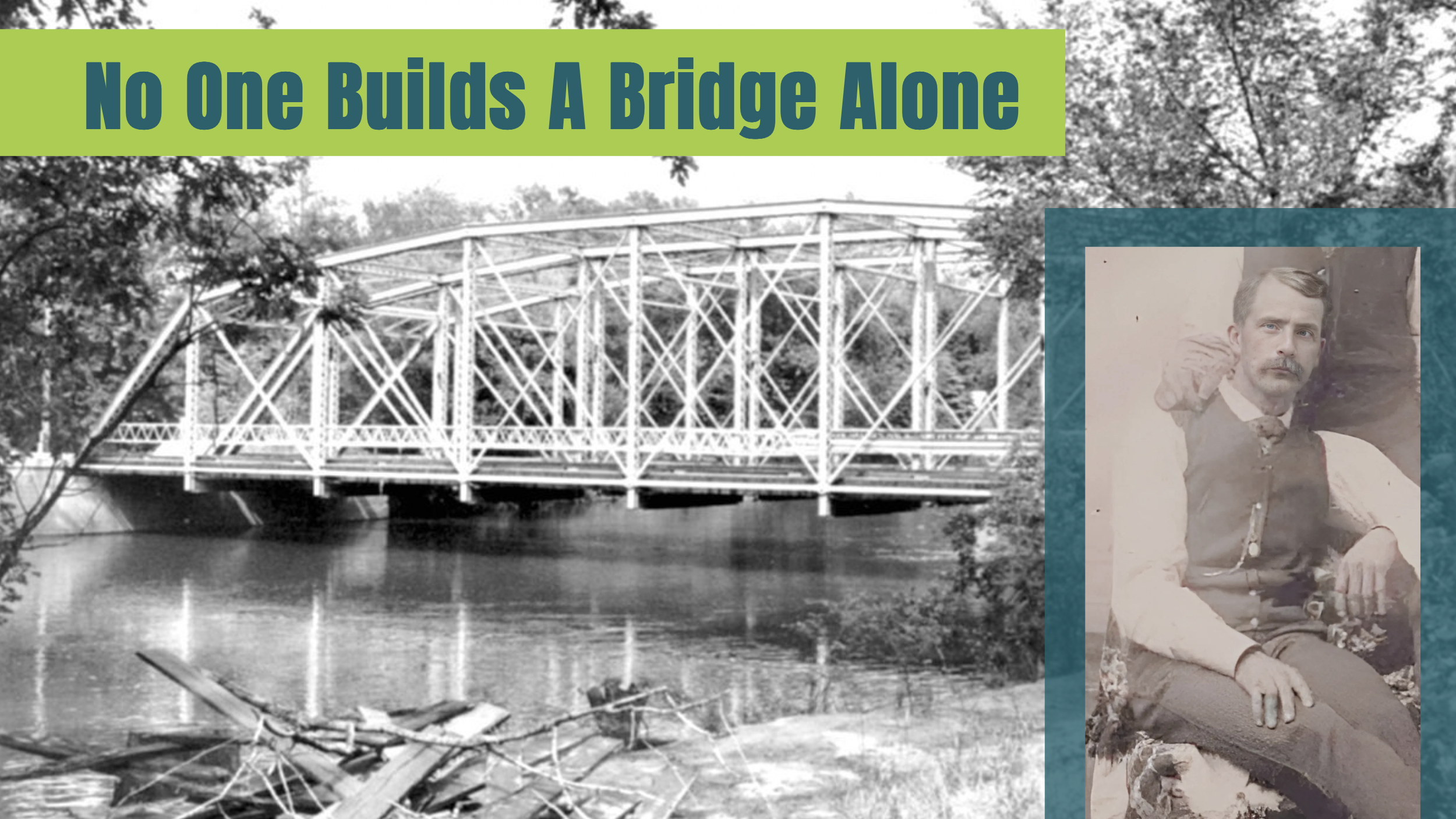
A picture of my great-grandfather, Olo, along with a photo of one of the steel truss bridges for which he was the construction superintendent and contractor in the early 1900s.
There are bridges in Indiana still standing today for which he led construction. When I was really little, and my mom would point out some of the bridges he built near where we lived, I imagined him building them alone as a one-man show with a blueprint and a dream. Somehow, in my mind, he was both the engineer and the entire construction crew.
Of course, as an adult, I know better. No one builds a bridge alone.
It takes people with different skills, different strengths, and different responsibilities.
It takes structure and pacing.
It takes clarity and communication.
And it takes a shared understanding of what we’re building and why.
It turns out: organizing people across a change initiative is exactly the same.
Every Change Is a Bridge
Every change — big or small — asks people to cross from what was to what will be.
Some bridges feel stable: the purpose is clear, expectations are communicated, and people feel supported. Others… wobble.
People don’t understand the “why.”
The emotional reaction isn’t acknowledged.
The change lands right on top of five other big priorities.
The pacing is chaotic.
Important voices are missing.
People aren’t equipped with the tools or clarity they need.
When one part of the bridge is shaky, people hesitate. When multiple parts are shaky, that’s when fatigue, frustration, and “quiet resistance” show up.
This pattern was so consistent across my work that over time it turned into something more structured, and eventually into a core Mosaic BizOps framework.
I call it The BRIDGE Test.
Introducing The BRIDGE Test
A people-centered framework for navigating change in a way humans can actually handle.
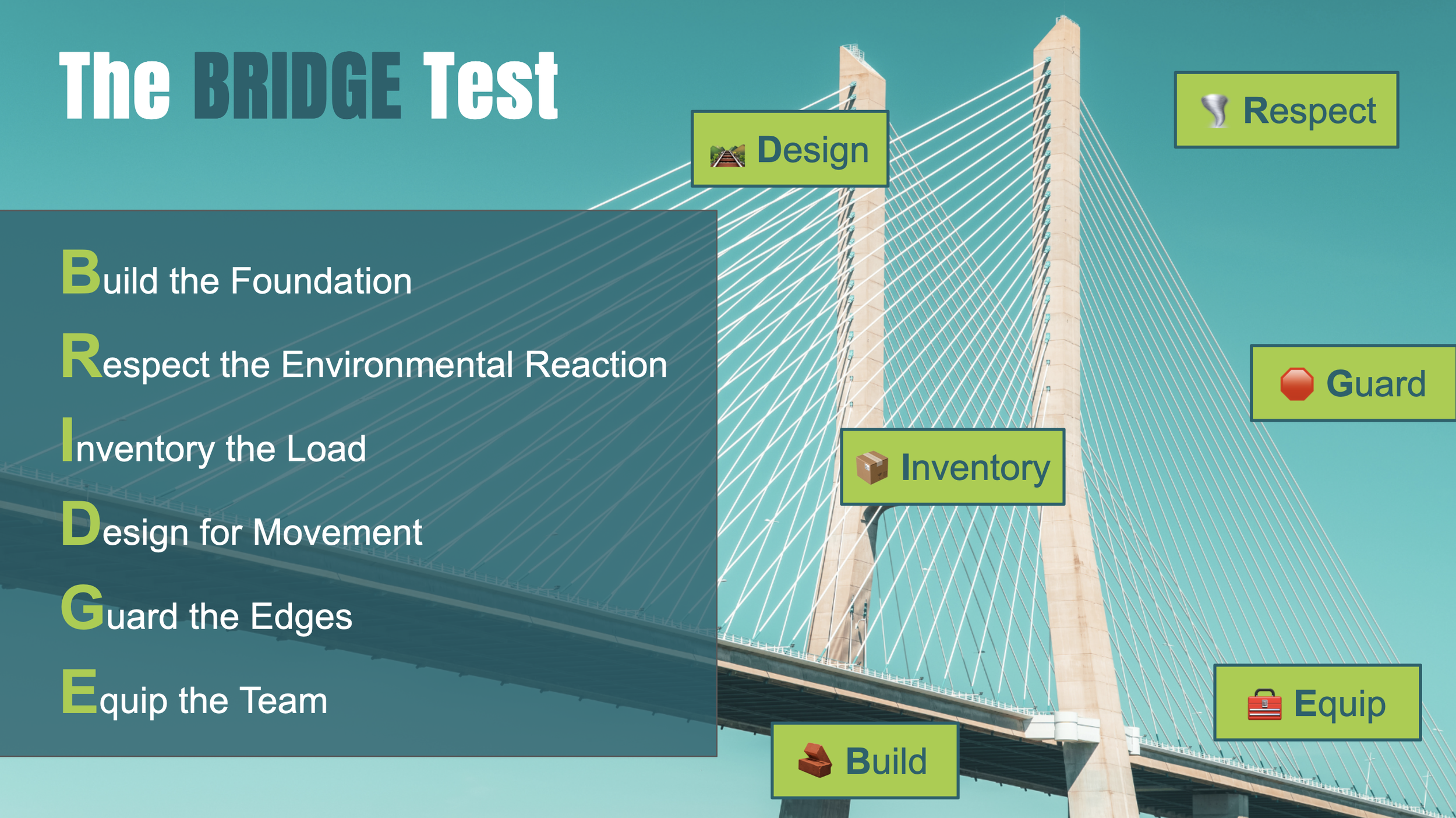
BRIDGE is an acronym…but more importantly, it’s a gut check.
A way to quickly assess whether your change has the structural integrity to carry people across without burning them out.
Here’s how it works:
🧱 B — Build the Foundation
Where are we going and why?
This is the grounding layer, the clarity layer, the “we’re not just doing this because someone said so” layer.
People can handle big shifts when they understand:
the purpose
the motivation
the intended impact
what success looks like
If the foundation is shaky, the whole change feels shaky.
🌪 R — Respect the Environmental Reaction
What will this change stir up culturally, emotionally, or historically?
Organizations are ecosystems.
Changes ripple through them in ways leaders often underestimate.
Respecting the reaction means acknowledging:
fear
fatigue
previous change trauma
the impact on workload
the emotional cost of uncertainty
This isn’t about slowing down. It’s about honoring the very normal, very human responses to disruptions so people feel seen instead of steamrolled.
📦 I — Inventory the Load
What else are people carrying right now?
This is the part leaders skip more than anything else.
You might be rolling out:
new software
a new workflow
a new org structure
a new initiative
But…what’s sitting underneath it?
If the change lands on top of five other priorities, three major deadlines, and someone’s onboarding process, no amount of “communication” will fix it.
Inventorying the load is an act of operational empathy.
🛤 D — Design for Movement
How will people move through this change?
Movement needs pacing. Pacing needs visibility.
Design for movement means:
creating a clear path from the old way to the new way
breaking the change into manageable steps
making progress visible and tangible
keeping people from feeling stuck in the “messy middle”
This is where teams feel the biggest relief because suddenly…the change has shape.
🛑 G — Guard the Edges
Who’s being impacted but not included? Who’s at risk of falling through the cracks?
Every system has edges…you know, the places where communication doesn’t reach easily, roles overlap awkwardly, or power dynamics make it harder for people to speak up.
Guarding the edges means protecting:
frontline staff
new team members
managers stuck between strategy and execution
people doing invisible labor
people who weren’t consulted but will carry the weight
Strong bridges honor every traveler, and not just the ones in the room where decisions are made.
🧰 E — Equip the Team
Do people have what they need to succeed?
This one might sound obvious, but you’d be surprised how often teams are asked to adopt a new system, workflow, or structure without:
clear documentation
expectations
training
scripts/templates
emotional support
space to practice
When people feel equipped, they feel capable. When they feel capable, they move.
These Aren’t Steps — They’re Conditions
One important thing about The BRIDGE Test: It’s not linear. It’s structural.
You don’t “complete” each stage like a checklist. You assess the conditions and reinforce where needed. Think of it as maintenance: ongoing, thoughtful, responsive.
Every bridge needs upkeep.
Why This Especially Matters for Nonprofits and Small to Mid-Sized Consulting Firms
In these organizations – that driven by their mission and/or every last billable hour really counting – change fatigue can hit harder and faster.
Everyone is already wearing multiple hats.
Tools are often underutilized or stacked on top of old ones.
Communication is inconsistent because everyone is moving quickly from one project to the next.
There’s rarely enough margin for people to absorb sudden shifts.
Emotional load isn’t distributed equally as some folks carry a lot…quietly.
The BRIDGE Test accounts for this reality. It gives you a way to:
bring clarity to chaos
slow down just enough to prevent burnout
create shared understanding
make change feel human-sized
avoid the “announce and pray” [that people will just adapt the change] method
These are the kinds of structures that make change sustainable, not just possible.
A Simple Tool for When You Feel Stuck
As I developed The BRIDGE Test, I realized teams also needed a way to reflect collectively when they were overwhelmed.
That’s where the Change Agility Inquiry Map came in. It’s a companion tool to help teams step back and ask better questions before forging ahead.
It asks:
What are we assuming?
What might actually be true?
Who’s being affected but not heard?
What can we clarify, co-create, or communicate now?
These questions create space for honesty, and honesty is what keeps a bridge standing.
(If you want to visualize this, I’ve created a three-page worksheet sharing both The BRIDGE Test and the Inquiry Map you can use with your own team.)
Change Doesn’t Have to Feel Like a Cliff
You don’t need a heavy, academic change management plan to help your team adapt. You don’t need a year-long roadmap. You don’t need a perfect rollout.
You just need a bridge that can hold the weight of real people with real responsibilities and real emotions.
My great-grandfather Olo didn’t build bridges alone. Neither do you.
And if your team is standing at the edge of something new — a system upgrade, a workflow shift, a restructuring, a policy change — I’d love to help you build the structure that will carry them across.
One plank at a time. One conversation at a time. One human-sized step at a time.
A Tool for Bridging Change
If you’d like a downloadable version of The BRIDGE Test and the Change Agility Inquiry Map, featuring a robust list of coaching questions to ask for each pillar of the test, access my free worksheet here. Or if you’d like support applying it to your own change initiative, let’s chat.
You don’t have to build the bridge alone.