
I See a Pattern. But Do I Understand the Pattern?
A last-minute vacation pivot sounds like it should begin with a fairly simple question:
Where could we go?
That was the question I was trying to answer recently when my plans to go on a group trip to Ireland suddenly changed and I found myself researching alternative travel options for my sister and me for the following week.
I started with guided tours in Scotland, Italy and Portugal. Reasonable enough.
Then I needed to know whether airfare still had confirmed capacity for two people. That led to Indianapolis versus Chicago departures, which led to European gateway cities with “affordable” airfare last minute, which led to wondering whether we could fly into Dublin and continue to Edinburgh.
Then my AI-assisted travel research sent me down the rabbit hole of UK travel authorization requirements, including the difference between an ETA and ETIAS. My sister and I paused to consider whether another European country might simply be easier to enter on short notice.
At some point, our question had very clearly stopped being, “Where should we go?”
I looked at domestic guided tours, and European cruises that still had capacity for our preferred dates. We narrowed it down to the Iberian Peninsula, and then I started targeting hotels near the Lisbon cruise port. And it went on and on:
Whether those hotel locations were also in districts we might actually enjoy as tourists.
Free cancellation policies.
Breakfast add-ons versus nearby cafés.
Medication restrictions in Spain.
Transportation from the Lisbon airport.
It felt endless for about 48 hours, and somewhere between researching UK travel authorizations and comparing the cost of a Lisbon hotel breakfast to nearby breakfast options, I had a realization:
Well, apparently even my vacation planning has turned into systems work. 🫠
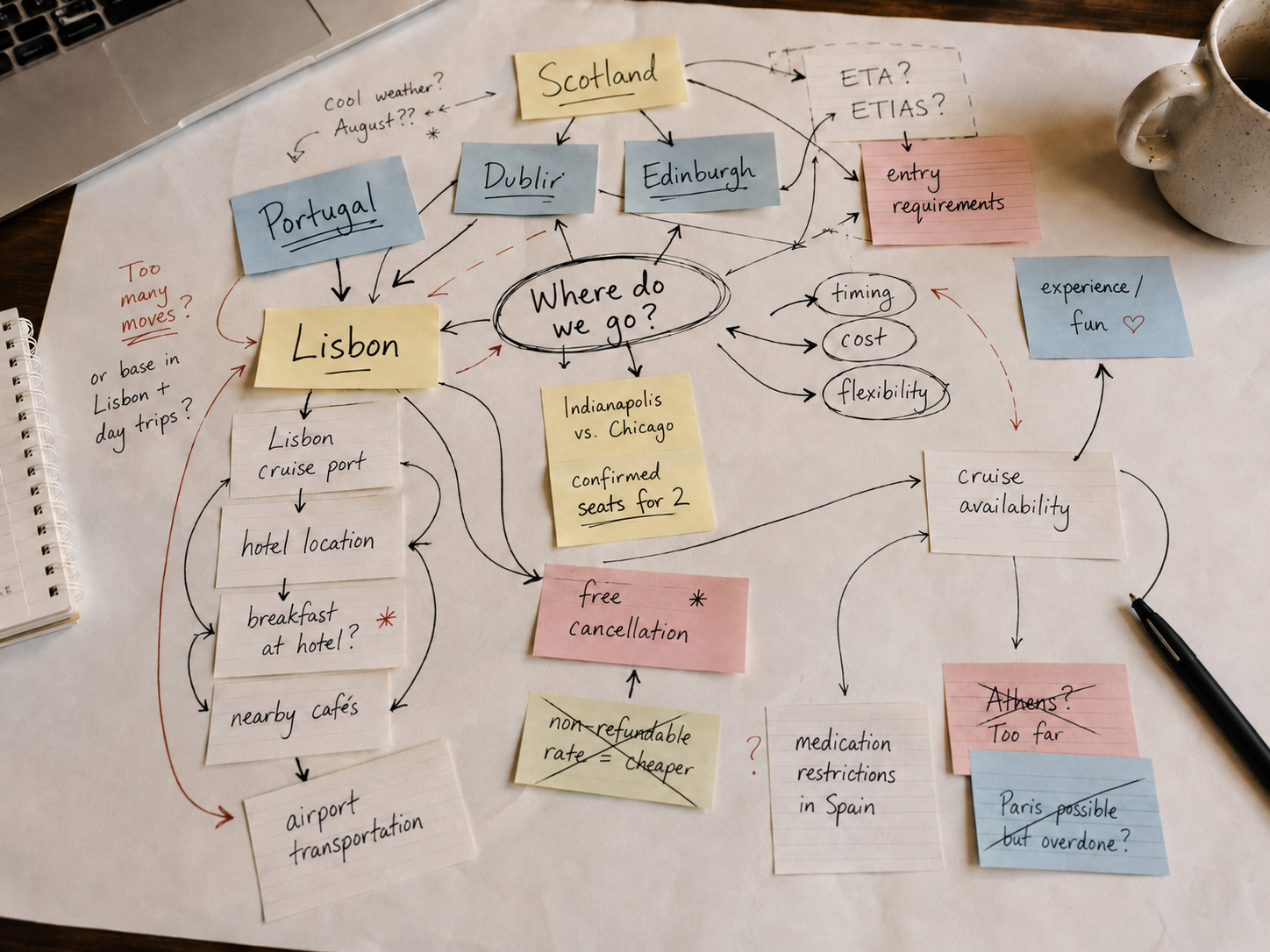
I thought I was planning a trip. Apparently, I was building a cluster map.
Well, not literally (as you can tell the above image was created with AI!). There were no sticky notes covering the wall or mapped out on a Canva whiteboard, and no color-coded diagram that would make our other family members question whether we were taking a vacation or launching a strategic initiative.
But mentally, I had started grouping the questions.
Travel logistics. Cost. Timing. Entry requirements. Transportation. Lodging. Flexibility. Experience (we must have fun, of course!).
Each new piece of information we uncovered in our research led to something else. Some variables were hard constraints, and others were preferences. A few were dependencies. And some became completely irrelevant as soon as another decision changed.
I wasn't working through a checklist; rather, I was working through a system.
The first problem we notice may only be the first node
My accidental vacation-planning system brought me back to something I've been thinking about through my recent organizational development (OD) coaching coursework: pattern recognition.
I tend to notice patterns quickly. This has been true most of my life, and it shows up in my CliftonStrengths, too, with Maximizer among my top five. Give me several pieces of information and I will naturally start looking for connections, grouping themes, and building a story about what may be happening.
That ability has served me well in business, though it also creates an interesting reflection question for me:
When I notice a pattern quickly, how can I use that awareness to become more curious instead of more certain?
Because there is a subtle difference between saying, “I see a pattern,” and deciding, “I understand the pattern.” The first statement creates a hypothesis, but the second can quietly become a diagnosis.
In organizations, we do this all the time: we notice that the hiring process is taking too long, so we start redesigning interview steps.
Or we see low adoption of a new CRM, HR system, marketing automation tool, or project management platform, so we plan more training.
Maybe a marketing team lacks visibility into the pipeline, so we decide the CRM needs to be cleaned up.
Any one of those observations may be accurate; however, the risk is assuming that the first visible problem is the whole problem. Sometimes it is simply the first part of the system we noticed.
A cluster map creates a useful pause
One tool I have been reacquainted with recently via my OD coach coursework is the cluster map.
Despite the name, you don’t need to consider yourself a systems thinker or own an impressive collection of facilitation markers to use one.
The basic idea is straightforward:
Put the issue or question you are exploring in the center.
Around it, capture the factors, people, constraints, conditions, and questions that may be related to the issue.
Then, start looking at the connections.
This is where the questions get interesting:
What influences what?
Where are there dependencies?
What keeps recurring?
Who’s affected? Is their perspective represented in our understanding of the problem?
What changes downstream if something shifts here?
Where might a relatively small change create a larger ripple effect?
What does the data tell us? And what might the people experiencing the system know that the data cannot show us on its own?
The point isn’t to create a longer and more intimidating list of problems. Systems thinking is not simply “consider more things.” The useful work begins when we examine how the different parts interact.
That's why the cluster map itself isn’t the real product. You can create a very attractive diagram and still learn absolutely nothing. I say this as someone who definitely appreciates both a good visual and a clean PowerPoint slide!
The real value is in what you begin to notice while you're building and examining the map. It can help a team move from:
“Here is the problem.”
to:
“Here is what we currently believe may be happening in the system.”
That’s a very different starting point, and it creates more room to learn.
One decision rarely stays in one place
Choosing new software is a good example because it often begins with what sounds like a fairly contained question.
Which platform should we choose? So we make a feature list.
But process needs connect to integrations. Integrations affect implementation. Implementation depends on internal capacity. Configuration choices create ongoing administration needs. Training affects adoption. Reporting requirements may change ownership.
Is your head spinning yet?
The challenge is that a decision in one part of the system rarely stays neatly contained there.
Choose the most feature-rich tool --> More complexity to configure, govern, and maintain
Prioritize integrations --> More implementation dependencies and technical coordination
Select a highly configurable system --> Greater need for clear ownership and ongoing administration
Compress the implementation timeline --> More human effort, training pressure, and adoption risk
Expand reporting capabilities --> New questions about data ownership and who maintains what
Solving one node can create pressure somewhere else. A checklist can help you compare software, but a cluster map may help you understand what you are actually asking the organization to absorb.
That pause can feel slower at first, but one recent reminder from my class has really stuck with me: mapping can act as a brake that helps us move faster later. I like that framing.
Not every problem needs six months of analysis and an elaborate systems map. Small and midsize organizations rarely have the appetite—or frankly, the bandwidth—for analysis that becomes its own permanent initiative.
However, taking enough time to untangle a complex problem and see the relationships can keep us from moving very efficiently in the wrong direction.
Curiosity is part of the work
This is the part I am sitting with in my own work: experience creates pattern recognition...and pattern recognition is incredibly useful!
Leaders, consultants, coaches, and experienced business practitioners should be able to draw on what we have seen before. We should absolutely notice themes and form hypotheses.
But experience can also make it tempting to recognize a familiar pattern and move too quickly toward an answer. That's where curiosity becomes part of the work.
The hypothesis is a starting point, not the conclusion.
What else could be connected?
What might I be missing?
Where is pressure showing up elsewhere in the system?
Those questions create space to test the pattern instead of simply trusting that I have seen this movie before.
Sometimes, I may still land exactly where my experience initially pointed me. But the process of mapping helps me understand why — and gives me a better chance of noticing when the situation is not quite as familiar as it first appeared.
Before you build the checklist
There is a place for checklists. I love a good checklist. For the record, I did eventually need to book actual travel rather than spend the following week creating an increasingly sophisticated model of our vacation options.
But checklists work best once we have enough clarity about the work we are trying to do.
When a problem is interconnected, beginning with the checklist can lock us into the first version of the problem we noticed. Mapping the clusters gives us a chance to see more of the system first.
It helps us notice relationships and dependencies. It surfaces questions we haven’t answered. It may reveal that the issue we were preparing to solve is connected to a completely different pressure point.
I'm still learning to ask myself: When I notice a pattern quickly, how can I use that awareness to become more curious instead of more certain?
Sometimes the goal isn't to find the answer faster; it’s to see the problem more clearly.
And then, yes, of course we can build the checklist after that!
