
When the Real Problem Isn’t the One on the Agenda
In my experience, some of the thorniest work challenges aren’t difficult because people lack the communication skills required to solve them. They’re tricky because conversations never uncover the deeper core issue; and, instead they just skim the surface of the presenting problem.
Teams can easily over-index on time spent discussing processes, timelines, or tools when the underlying issue is something more sensitive such as misaligned priorities, shifting expectations, or uncertainty about psychological safety when speaking candidly.
Until the deeper layer emerges, conversations might circle around the same operational problems…without much progress. For those who have worked with me before, they know that I call that behavior “talking about talking about it.” 😉
When a Team Tries to Introduce a Better System
I was reminded of this recently while thinking about how teams try to introduce new systems or ways of working within their organizational culture.
For example, let’s say that a department has been asked to pilot a more structured approach to managing projects across their organization. The goal is to bring more clarity to how work moves: clearer intake requests, shared dashboards, and regular status updates so everyone can see how projects are progressing and where bottlenecks might be forming.
The pilot team includes:
Elena, a manager responsible for leading the effort;
Mark and Priya, two experienced individual contributors who work closely to the day-to-day delivery of projects; and,
several other teammates who will ultimately need to help make the new process stick across the organization.
On paper, the system makes sense. In practice, however, adoption ultimately proved to be uneven.
Fast forward a bit post-implementation, and some requests still arrived through side conversations instead of the formal intake process. Updates appeared late, or not at all. A few team members quietly reverted to their old habits of tracking work in personal spreadsheets and inbox folders.
Then, during a regular virtual working session, the group gathered to talk through what wasn’t working. Elena quickly focused the conversation on the mechanics of the new process.
Maybe the intake form needed to be simplified.
Maybe the team should send more reminders for status updates.
Then, Mark suggested adding another column to the dashboard so people could see dependencies more clearly.
And, building on the discussion momentum, Priya decided to build a new automation rule to surface important reminders to stakeholders on the project.
Each suggestion seemed reasonable on its own, but the discussion felt strangely circular. The team kept adjusting the system, but nothing seemed to address the underlying frustration everyone was feeling.
The Moment the Conversation Changed
About halfway through the call, Mark unmuted and said, “Can I say something…umm…honestly?”
The group paused before Elena nodded to urge him forward.
Mark hesitated ever so slightly before reluctantly continuing. “I think part of the problem is that some of us are worried about pushing this process too hard. If we enforce it consistently, and the leadership team still keeps shifting priorities or bypassing our system, we might end up looking like the ones who are slowing things down.”
The screen appeared to freeze as if the connection became unstable, but actually everyone just paused [in real life] at that exact moment.
Then…two small thumbs up emojis flew across the meeting window. 👍 A moment later, a more emphatic applause emoji joined them. 👏
Priya leaned forward. “I’ve actually been thinking the same thing,” she said. “It’s hard to ask everyone else to follow the system…or even muster the effort to do it ourselves…if we’re not sure the organization will actually use the information we’re collecting.”
Another voice added, almost cautiously, “And honestly… sometimes it feels a little risky to say that out loud.”
Then, something shifted on the call.
Up until that moment, the team had been discussing dashboards, workflows, and project updates as the presenting opportunity. But now the conversation had moved somewhere deeper…layers of the metaphorical organizational onion had simply been peeled away.
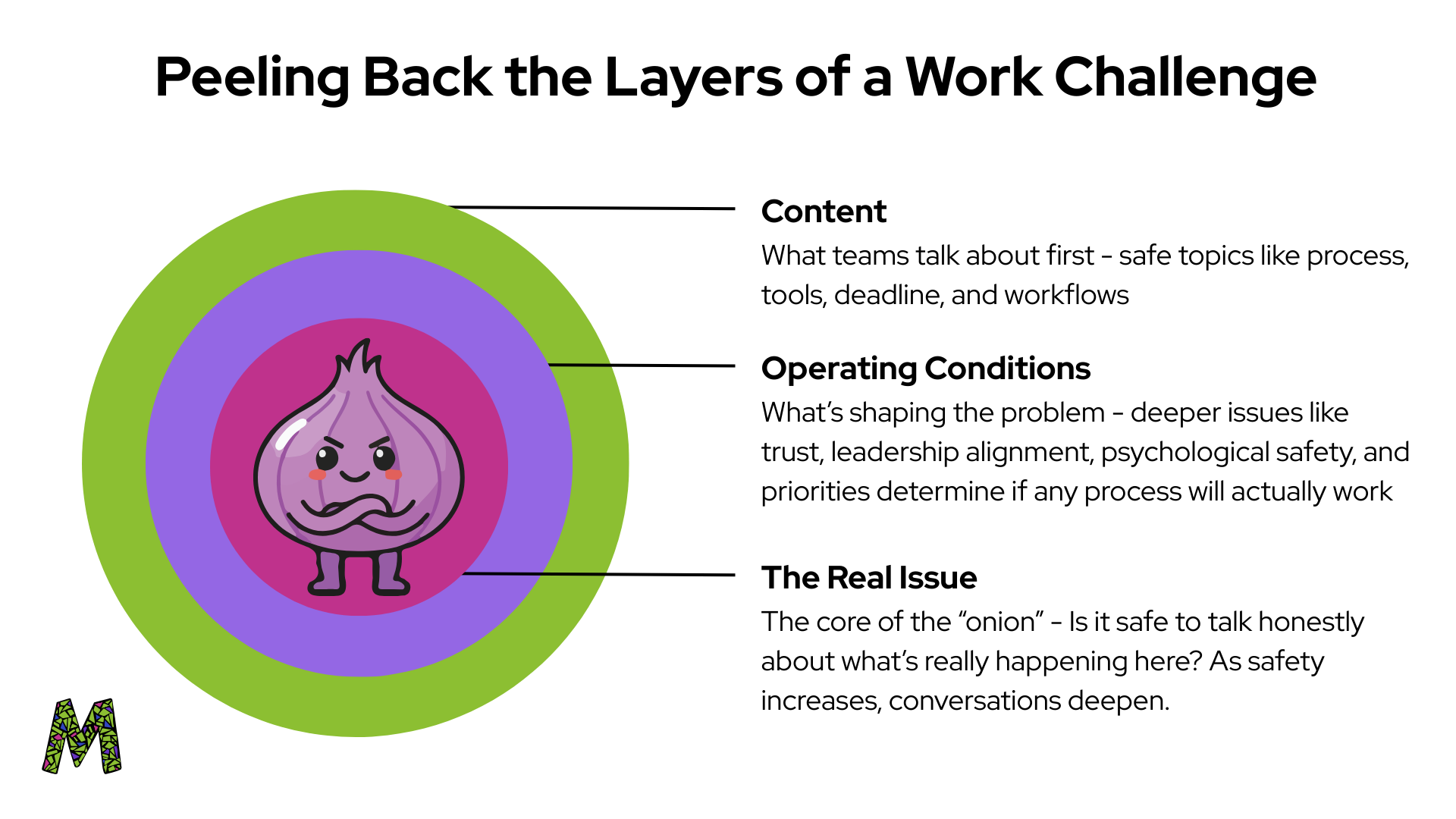
Infographic with visual of layered onion illustration to represent the layers of a work challenge.
The challenge they were facing wasn’t really about the process itself. Instead, it was about whether people felt safe enough to talk honestly about the conditions surrounding it.
Why Psychological Safety Determines Whether Teams Reach the Real Issue
I recently listened to one of the latest iterations of the classic business book, Crucial Conversations, and moments like those represented in our aforementioned team parable illustrate something the book authors emphasized, too:
When people don’t feel safe in a conversation, they rarely get to the real issue. Instead, they talk about a [surface-level] version of the problem that feels less risky to discuss.
They stay on the papery, brittle, outer skin of that onion.
Over the course of many early meetings, this team had spent most of their time talking about the mechanics of the project management system (e.g., forms, reminders, dashboards, and process tweaks). Those were real operational details, and undoubtedly there were some true opportunities to become more efficient in the mix; however, solving for those presenting details would not magically make the system adoption easier.
Over time, the team realized that the deeper concern was whether the broader organizational environment would actually support their new way of working. If leadership priorities shifted unpredictably or bypassed their system entirely, they worried they might be the ones held responsible for slowing things down. That uncertainty made it risky to push too hard for change; or, risky to experiment and demonstrate an iterative, growth mindset.
Once Mark and Priya voiced their true concern out loud, the conversation shifted almost immediately. The team wasn’t just debating process adjustments anymore; they were finally discussing the deeper challenge surrounding the process itself…and the action steps they could start taking to chip away at the true challenge.
Three Lessons About Safety and Systems Change
A few insights from Crucial Conversations that were reflected in this team story have stayed with me.
Teams Tend to Default to Solving the Safest Version of the Problem
First, teams often spend energy solving the safest version of a problem instead of considering what I refer to as the [tongue-in-cheek] “rip-off the bandage” approach. It’s far easier and more comfortable to debate process mechanics than to raise concerns about leadership behavior, shifting priorities, or organizational trust.
But, when those deeper dynamics are left unspoken because conversations haven’t had the right level of safety restored, the operational fixes rarely stick.
Process Only Works When People Really Believe the Process Matters
Systems only work when people believe the system actually matters. Introducing new tools, dashboards, or workflows requires a certain level of trust that the effort will improve outcomes (said more plainly, “what’s in it for me?”).
If team members suspect that decisions will continue to happen outside the system (or that the signals the system produces will be ignored or minimized) it becomes a fool’s errand to ask them to invest energy in adopting it.
Communication Safety Changes the Quality of Participation
Finally, communication safety changes the quality of stakeholder participation. In the team story, the conversation became noticeably more productive once someone was willing to be vulnerable and name the underlying issue.
People affirmed the concern, and then eventually began contributing ideas, acknowledging tradeoffs, and volunteering to help move the work forward. The process itself hadn’t changed yet, but the conversation about it had become more honest.
When teams find themselves “stuck” trying to improve a process, it’s tempting to keep refining the plan. But, sometimes the more important question is whether people feel safe enough to talk about the conditions that surround that plan.
Until the real problem makes it onto the agenda, even the best-designed system will struggle to take hold. From what I’ve seen, some of the most productive operational improvements begin not with redesigning the workflow, but with creating the psychological safety required to talk honestly about what’s really getting in the way.
Remember, dig for the core of the onion!
