
The Ownership Gap Hiding in Your Change Initiative
Let’s imagine a growing organization has finally decided to replace the HR platform it has clearly outgrown.
On the surface, this seems like an HR project, right? Human Resources knows the current system, hears the complaints about what isn’t working and will ultimately live with much of the day-to-day administration. So, naturally, HR takes the lead.
Except Finance needs to weigh in on payroll and reporting, and managers have opinions about approvals, recruiting and onboarding. And by the way, IT may need to evaluate integrations, security and access while someone else has to gather business requirements before the team gets too distracted by shiny vendor demos. Leadership also needs enough information to approve the investment. Once a platform is actually selected, there’s still data cleanup, configuration, testing, implementation, communication, training and rollout to coordinate.
This is where things can get a little slippery: lots of people may own important pieces without anyone really owning how those pieces come together. And, of course, the task list keeps getting a little longer every time someone says, “Oh, and we’ll need to…” (which happens with decent frequency).
Before long, there may be a healthy collection of smart and capable people attached to the project. Each person will have a legitimate role to play, and there may even be a thoughtfully organized project plan showing exactly who owns each deliverable.
And yet, the project starts to drift, creep and stall.
A configuration decision sits unresolved because no one is quite sure who has final say. Meanwhile, the vendor assumes the internal team is handling something the internal team thought was included in implementation. As those details keep moving, communications get pushed back and training gets compressed toward the end because everyone has been so focused on getting the technology ready that there hasn’t been much time to think about getting the humans ready.
Of course, the people involved still have their regular jobs to do. (Apparently the organization did not agree to stop operating while the new human resources information system (HRIS) was being implemented. Rude, right?)
In this all-too-common situation, nobody is necessarily dropping the ball. In fact, everybody may be working pretty hard.
The problem is that while plenty of people own pieces of the change, no one has really been asked to own how those pieces fit together.
A filled-in project plan can still have an ownership gap
This is one of the things I find particularly interesting about change work in small and mid-sized organizations. An HRIS migration can look fully staffed in a project management tool because nearly every task has somebody’s name next to it. HR owns requirements. Finance is validating payroll. IT is handling integrations. Someone in communications is preparing announcements, managers are expected to reinforce the change with their teams, the software vendor has its own implementation checklist, and an executive sponsor is available when something needs approval or visible endorsement.
Technically, everyone owns something, but who is paying attention to the spaces between those responsibilities?
This is important because one decision rarely stays neatly contained in its own corner of the project. A configuration choice made by IT today might mean managers need a different message next week. Then employee questions start coming in, and what first looks like resistance turns out to be confusion about how the new workflow is supposed to work.
Elsewhere in the project, an integration delay that seems fairly technical on paper can quietly push training off schedule. And every so often, a policy question surfaces that needs executive input...usually at the exact moment the project is already waiting on the answer.
Those connections are easy to miss when everyone is understandably looking through the lens of their own responsibilities. Someone needs enough visibility across those responsibilities to catch what each team might miss on its own.
I’ve written before about why it’s worth doing the readiness work before software selection, because technology decisions rarely stay neatly contained within the technology itself. The same is true once implementation begins. Someone needs to keep watching how decisions in one part of the system ripple into another. Otherwise, the project can be “owned” by lots of people while the actual change is owned by no one.
What an ownership gap tends to look like
Ownership gaps don’t always show up as a dramatic failure (if they did, we’d spot them a mile away). More often, there’s a collection of small, individually reasonable frustrations that slowly begin to add up.
You might notice that:
Dates keep sliding, but every delay has a perfectly defensible explanation. One dependency slipped, then another task had to move, and eventually the launch date has quietly migrated two months to the right on your trusty Gantt chart.
The same decisions keep resurfacing. They get discussed in one meeting, revisited in another and occasionally make a guest appearance on an executive agenda because no one is quite sure who has the authority to finally close the loop. As I like to say, you keep “talking about talking about it.”
Communication and training are treated as downstream tasks. Everyone knows they matter, but they stay safely in the “later” portion of the plan until suddenly “later” has snuck up on you and someone needs to explain a fairly complicated new way of working two days from now.
Each function is managing its own piece reasonably well, but dependencies are discovered late. The issue isn’t necessarily poor execution; it’s that no one has enough visibility across the project to recognize the collision…or the missing prerequisite that causes a huge stall before it happens.
Stakeholders keep coming back to leadership with some version of, “We really need to get this moving again.” If that sentence has become a recurring agenda item, there may be something worth examining beyond the project timeline.
Any one of these things can happen even on a well-led project, of course. Change is messy, and I have yet to encounter the mythical implementation where every dependency politely reveals itself at kickoff.
But when several of these patterns keep occurring, I’d start asking whether the problem is really effort...or whether the work is missing orchestration.
Someone has to listen for whether the pieces are making music
To be clear, I’m not advocating for the creation of one heroic human who becomes the organizational junk drawer for every task no one else wants.
A change owner doesn’t need to personally write every communication, configure every workflow, train every employee or sit in every vendor meeting. In fact, if they’re doing all of that, we have created a different capacity problem.
I think of the role a little more like arranging music. You still want the right people playing the parts that match their strengths and expertise. HR brings the people perspective. IT understands the technical implications. Finance may be watching payroll and reporting closely, while managers often have the clearest view of how the change will actually land with their teams. But someone also needs to listen for whether those parts are actually coming together.
That may mean coordinating the project plan and its dependencies, but it also means keeping an eye on the less-visible work: internal communication, executive sponsor involvement, stakeholder feedback, training, adoption, decision-making and the occasional coaching or facilitation conversation when the issue is no longer tactical.
It’s the difference between asking, "Did everyone complete their assigned task?" and asking, "Are we still creating the outcome we intended?" Those aren’t always the same question.
When an internal change owner is the right fit
The good news is that recognizing an ownership gap does not automatically mean an organization needs to hire someone new.
Sometimes an internal employee is exactly the right person to lead the work. They may already have credibility across the affected teams, enough organizational context to understand where the landmines are buried, and the kind of project leadership ability that helps people move together.
But there’s an important caveat here: if we give someone ownership of a significant cross-functional change effort without taking anything else off their plate, we haven’t actually created capacity. We’ve mostly created a very flattering invitation to work more hours.
If the organization wants an internal leader to own the change, that role needs to be treated like a real temporary assignment. Consider these questions:
What can be delegated or deprioritized while the initiative is active?
What authority does this person have to convene stakeholders, request decisions and escalate issues?
Does everyone else understand the role they’ve been asked to play?
I think organizations sometimes underestimate this piece because assigning ownership feels administratively simple. In practice, ownership without capacity, authority or visible sponsorship can become its own bottleneck.
When fractional or hybrid change leadership makes sense
There are other times when an internal owner isn’t the most practical answer...or at least isn’t the whole answer.
A fractional change and systems leader can be useful when an initiative crosses several functions, senior leaders are already stretched, the organization needs someone who has led similar work before, or there simply isn’t someone who can keep the project moving, communicate clearly, spot cross-functional dependencies and help people navigate the change.
There can also be value in bringing in someone who isn’t embedded in the existing organizational history. An outside leader may notice a cross-functional pattern that has become normal to everyone else, ask a question people internally have stopped asking, or serve as a neutral point of coordination when stakeholders have different priorities.
That doesn’t make fractional leadership inherently better than internal ownership. It simply solves for a different set of conditions.
And then there’s the hybrid option, which I think organizations sometimes overlook. Perhaps an internal leader is absolutely the right long-term owner, but they haven’t led this kind of change before or don’t currently have enough bandwidth to carry every part of it. An outside partner can help establish the project structure, coach the internal lead, facilitate difficult conversations and take on some of the execution while the organization builds capability from within.
In other words, the staffing question doesn’t have to begin with, “Do we need a consultant?” A more useful place to start might be:
What does this change require someone to hold...and who is best positioned to hold it right now?
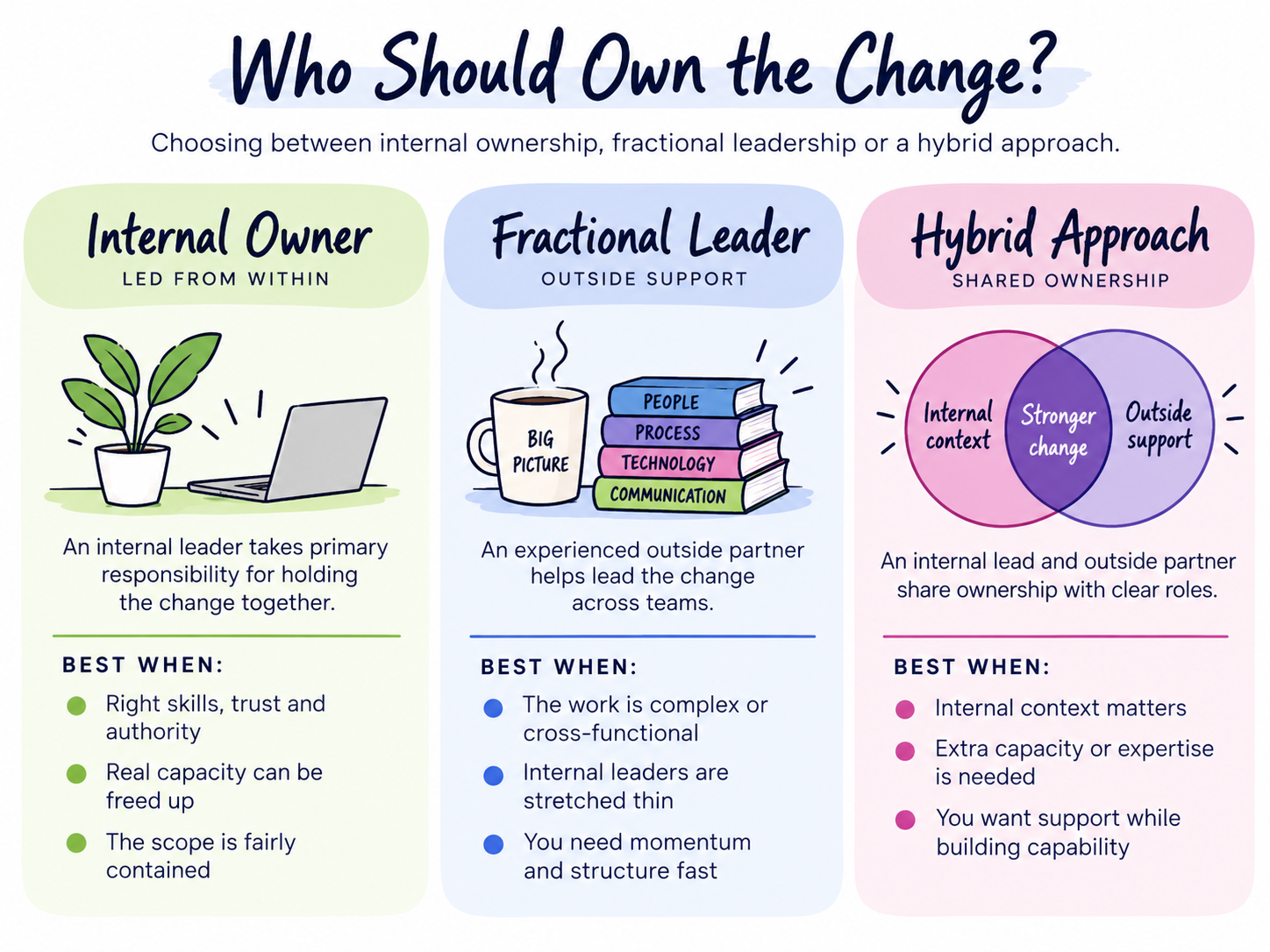
There’s no single right way to staff change leadership. The best approach depends on your internal capacity, the complexity of the initiative, and how much outside support or expertise is needed.
An internal owner, a project-based change partner, a fractional leader or some blend of those approaches could all be perfectly reasonable answers depending on the complexity of your initiative, the experience already on your team, and how much genuine capacity exists.
The trick is being honest about those conditions instead of hoping ownership will somehow emerge because enough people have been invited to the meetings.
Who owns the whole change initiative?
I suspect ownership gaps are especially easy to miss because, from the outside, nothing appears to be missing. The project plan has names next to the tasks, meetings are on the calendar, the vendor is sending updates and leaders are hearing enough about progress to assume the work is moving.
What’s harder to see is the connective work in between.
A decision made in one corner of the project can quietly change what’s needed somewhere else, and someone has to be looking broadly enough to catch that ripple. Executive intent still needs to be translated into what people should actually know or do differently. At the same time, the project needs enough structure to keep moving without becoming so rigid that the team can’t respond when implementation teaches them something new.
That broader view is what helps all of the individual contributors do their own work more successfully. They can each be responsible for their part, but someone still needs to know whether the whole thing is coming together.
So, if an important change initiative keeps stalling, I wouldn’t automatically assume that you need a better project plan, another committee or one more standing meeting (because nothing says progress like another recurring meeting).
Instead, I’d ask:
If this initiative stalled tomorrow, who would notice first...and who would have both the responsibility and the authority to get the whole thing moving again?
If it takes your team a while to answer that question, you may have found the gap.
If the ownership gap feels familiar…
If this feels familiar and you’re not sure whether your change needs a clearer internal owner, outside support or some combination of both, that’s the kind of knot I help organizations untangle. Mosaic BizOps can help clarify ownership, connect the moving pieces and add experienced change leadership without automatically adding permanent headcount.
If you have an initiative that keeps stalling despite plenty of smart people being involved, let’s talk about what might be missing.
