When Everything Feels Urgent: A Lighter Way for Marketing Teams to Work
If you lead or work with a marketing team, there’s a good chance this feels familiar.
The marketing function is a shared service. Requests come from everywhere: programs, leadership, fundraising, sales, events, sponsors. Each request makes sense in isolation. Each one feels important. And each requester is usually looking at their deadline, not the team’s full capacity.
From the outside, it can look like marketing just needs to “move faster.” From the inside, it often feels like work is being thrown over the wall from all directions.
When everything feels urgent, the problem usually isn’t effort or talent. It’s that the work…and the tradeoffs…are largely invisible.
Over the past few years, I’ve been supporting teams caught in this exact dynamic. Not because they’re doing anything “wrong,” but because they’ve outgrown the informal ways of working that used to get them by. What’s helped isn’t a heavy framework or strict process — it’s a lightweight, people-centered operating system that brings clarity without killing creativity.
Some call it “agile-lite.”
The hidden cost of operating in reactive mode
In small and mid-sized organizations, marketing teams are often asked to be flexible, responsive, and fast…all at once.
Over time, that shows up as:
calendars packed with back-to-back meetings that turn into working sessions
late-stage changes because inputs arrived too late
rework when approvals or expectations shift midstream
leaders quietly absorbing stress so the team can keep moving
None of this happens because people don’t care. It happens because urgency becomes the default, and there’s no shared way to see or manage the load.
In one team I worked with, every request they received felt as though it should be able to be done “quickly” (no big whoop, right?). Individually, that was often true. Collectively, however, they added up to weeks of work. By the time the team realized they were overloaded, deadlines were already at risk and everyone was frustrated…even though no one had done anything malicious or careless.
Teams in this mode don’t need more hustle. They need a way to make work visible early enough to have real conversations about priorities.
Why agile-lite (and why not full-blown Agile)?
At its core, pure Agile is a way of working that emphasizes short planning cycles, visibility, feedback, and adaptation. It was originally developed for software teams, but has been increasingly applied elsewhere. The intent with it was never rigid process; it was responsiveness, learning, and trust.
But…let’s address the elephant in the room. Many people hear “Agile” and picture:
rigid ceremonies
unfamiliar jargon
a framework built for software, not creative work
That’s not what this post is about, though. This interpretation of agile-lite is about borrowing a few principles that help teams:
see all the work in one place
commit to a realistic amount of work for a short window
surface blockers early
adjust intentionally instead of reacting emotionally
It’s not about perfection or certification. It’s about creating enough structure to protect focus and trust.
Step one: create a single source of truth for work
This is the least glamorous step, yet the most important.
Whether a team uses a project management tool, a spreadsheet, a shared board, or a very well-labeled document, the goal is the same: one place where all work lives.
Not some work. Not “the big stuff.” All of it.
When work lives across inboxes, chat threads, and people’s heads, it’s impossible to see true capacity. A single backlog doesn’t magically solve overload, but it makes tradeoffs visible before things break.
This is often the first moment leaders say, “I didn’t realize how much was already in flight.”
Step two: prioritization that acknowledges tradeoffs
In most organizations, marketing doesn’t fully control priorities — and that’s okay. What the marketing function can change is how requests are evaluated and sequenced.
Instead of “yes” or “no,” the conversation becomes: “Yes — and here’s what would need to move.”
That framing alone shifts the dynamic. It makes capacity a shared reality instead of a private burden carried by the team lead.
For example, I once watched a team leader go from absorbing every request to calmly saying, “We can absolutely do this. Let’s look at what it replaces.” The tone of conversations with stakeholders changed almost overnight. Not because priorities disappeared, but because tradeoffs were finally explicit.
Step three: short, manageable sprint commitments
Rather than planning months at a time, agile-lite uses short commitment windows that are often two or three weeks long. Short sprints work because:
they’re realistic to protect
they reduce broken promises
they make it easier to adapt when reality changes
But don’t get me wrong, interruptions still happen. That’s life.
The goal isn’t rigidity, but rather intentional adjustment instead of constant whiplash.
Building people-centered guardrails (scripts matter)
One overlooked part of this shift is language. Teams do better when they’re given simple, shared scripts to handle disruption without escalating tension. For example:
“We’re mid-sprint — let’s look at what would need to shift to accommodate your new, urgent request.”
“This change is doable, but it affects scope. Can we reset expectations together?”
“We can start this during the next sprint if it stays a priority.”
These scripts reduce emotional labor and keep one person from being the sole buffer between leadership and reality.
Where story points fit (without turning work into math)
Story points often get misunderstood as time estimates. In practice, they’re more about complexity. When used lightly, story points help teams consider:
number of stakeholders involved
uncertainty or ambiguity
likelihood of rework
cross-functional dependencies
They’re not about precision. They’re about learning and recalibrating over time.
In one sprint planning session I experienced, a piece of work everyone initially assumed was “small” (e.g., an event mailer) was adjusted to a higher point value because of its required approvals and dependencies (e.g., the team lead, other departments, and external sponsors had to sign off on it before subsequent work could being). That conversation alone prevented a late-stage scramble weeks later. Nothing about the work changed, but expectations about its likely complexity did.
If story points feel awkward at first, that’s normal. The goal isn’t math. It's a shared understanding.
What changes over time
Teams using an agile-lite approach don’t suddenly become slower or less creative. In fact, the opposite tends to happen once things fall into place over a few sprints.
Teams generally experience:
clearer capacity conversations
fewer last-minute emergencies
less emotional load on leaders
stronger trust with stakeholders
more space for thoughtful, creative work
Heroics get replaced with consistency. And that consistency builds confidence…on all sides.
This is about stewardship, not control
The biggest shift I see in successful teams is this:
Leaders stop acting as traffic managers — absorbing chaos and fixing everything — and start acting as system stewards.
Systems aren’t about control. They’re about care. They protect people, creativity, and trust.
If your team is starting to feel stretched, this isn’t necessarily a sign you need a rigid framework. It’s a sign you need a thoughtful one that’s designed for how people actually work.
A question to consider:
Where is your team absorbing chaos today that could be better supported by a system?
If this feels familiar, you don’t have to figure it out alone.’'
More People-Centered Ops Topics, Delivered Monthly
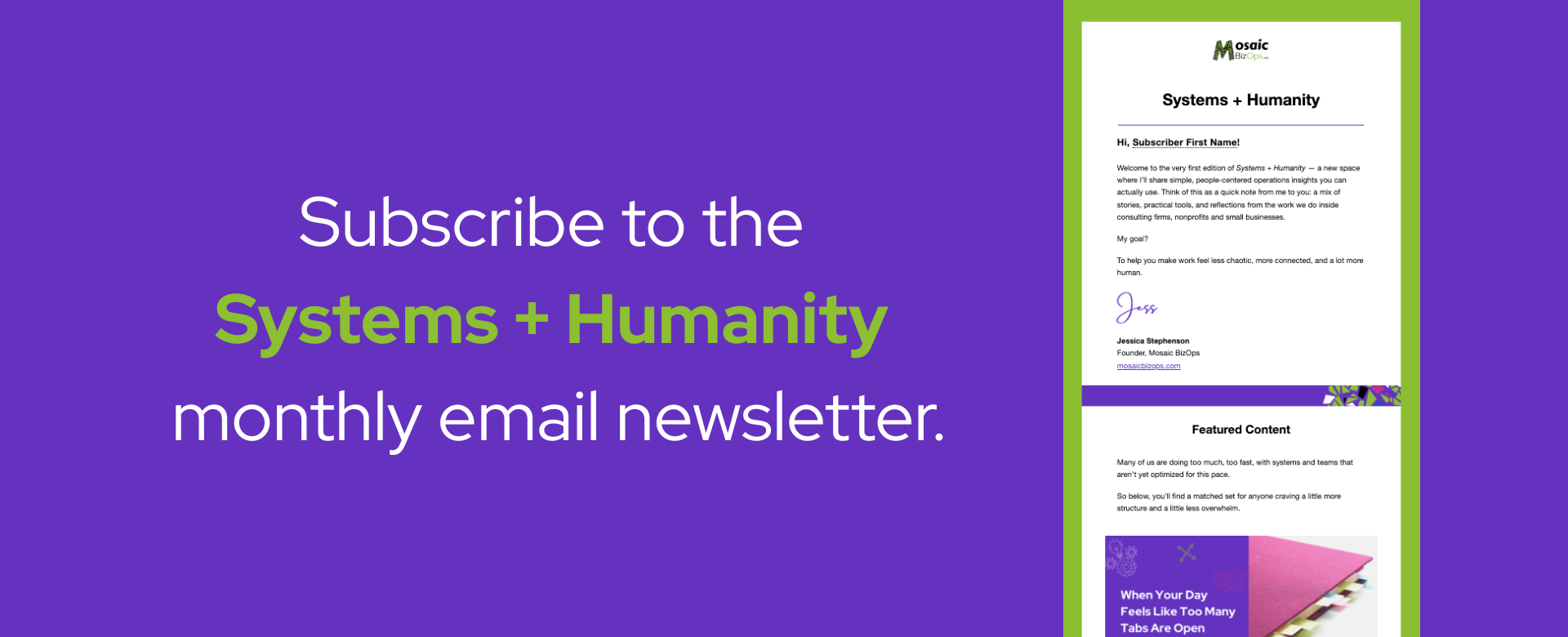
If you like thinking about the human side of systems — and the systems side of being human — you might enjoy my monthly Systems + Humanity email newsletter. It’s where I share stories, frameworks, and practical ops wisdom for teams who want their work to feel a little clearer and a lot more sustainable.